 The
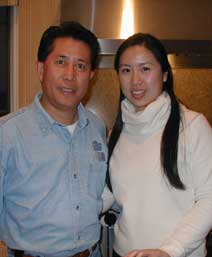
sun is beginning to set as I arrived at Chef Martin Yan's
Bay Area office. Before I even get out of my car, I notice
that his marketing/communications director is waiting to
greet me by the door. I am impressed by the marble floors
and high ceilings as I walk in. This is a beautiful building.
The
sun is beginning to set as I arrived at Chef Martin Yan's
Bay Area office. Before I even get out of my car, I notice
that his marketing/communications director is waiting to
greet me by the door. I am impressed by the marble floors
and high ceilings as I walk in. This is a beautiful building.
After
being introduced to the office staff, I am given a seat
by a still sunny window to prepare for the interview. Yan
soon pops through the French doors that connect the office
to a full kitchen. He is not clad in a stylish suit or chef's
uniform as I imagined he would be, instead he is wearing
a denim shirt, jeans cut at the ankle, and worn brown loafers.
"I was out gardening before you arrived," Yan explains with
a smile.
Our
grand chef enjoys "a simple life." But in fact it is a simple
and busy life. As a celebrity chef, honorary doctor of Humane
Letters with The Colorado Institute of Art, and the winner
of countless awards, a Daytime Emmy and two prestigious
James Beard Awards to name a few, Martin Yan's calendar
is perpetually booked full of public engagements and charity
events.
As it
is, immediately following our meeting Yan must set off to
prepare for a redeye flight to Chicago connecting to Louisville
for a fundraiser benefiting underprivileged children. But
nevertheless, he still has time to serve me tea and snacks.
And throughout our talk, he is gracious and attentive, never
rushed even though the phone is ringing and calls need to
be made.
At the
end of our interview, I leave with not only a tape of a
great conversation, but also with a knife personally sharpened
by the chef and three autographed books. I couldn't have
asked for more.
Kris:
Growing up, did you always know that you wanted to be a
chef? What inspired you to become a great chef?
Chef
Yan: First of all, I can't really claim to be a great
chef. I think that my inspiration had a lot to do with my
background. Just like if you were brought up on a farm,
you would most likely carry on your father's business as
a farmer; I was brought up in the kitchen and ended up becoming
a chef. My father owned a restaurant in China before I was
born, and even though the business was taken over by someone
else after my birth, I still hung around the restaurant
kitchen all the time.
At thirteen,
when I arrived in Hong Kong after leaving China, I made
a living by working in a restaurant. As a student at the
University of California, Davis, I taught Chinese cooking.
And after I graduated, I gained more experience working
with restaurants, writing cookbooks, and doing television
shows. So basically, I have been working with the foods
sciences, restaurants, food, and cooking all my life and
I just happened to have the opportunity to be on television.
One thing just led to another and now I've done probably
close to two thousand programs.
I remember
when I was in college, I used to watch Julia Child's cooking
show during dinner and joke with my roommates about becoming
a TV chef. Actually, the introduction to my new cookbook
will be an essay written by Julia Child. It will be the
first time that Julia's ever written an actual piece discussing
her love and passion for Chinese cooking and culture, so
it's very special.
I've
come a long way, been in the business a long time, and I'm
still enjoying myself. I think, just like with any profession,
whether you're considered to be a great chef or a great
athlete, it's the love and passion for your work that keeps
you coming back.
Kris:
Being great takes more than inspiration, you must have
a love and passion for what you do. You've had a lifetime
of achievement, won almost every coveted award out there,
what is it that continues to drive you in this business?
Well,
you know, if you get into the profession because you think
you can make a lot of money, you can never become successful.
I think a lot of times it's not money that's the primary
motivation factor; it's the passion for your job and the
professional and personal satisfaction that you get out
of doing what you do that motivates you. If you don't have
that passion, that love, sooner or later, you're going to
give up. Sometimes you face rejection, you cannot please
everybody, and what happens is that you get discouraged.
But
if you're passionate about what you do, it's all worth it
and you'll keep going. It is definitely difficult, but you'll
continue because you love it. Like today, I am flying out
to Chicago on a redeye flight when I just came back from
there yesterday.
But
the thing is that I love what I do. I don't like the travelling
part of it; travelling nowadays is very stressful, but I
have to travel in order to make a living. In fact, Chicago
isn't my final destination; from Chicago I have to get on
a connecting flight to Louisville to do a fundraiser for
underprivileged children. We're trying to raise scholarship
money, so that those kids will have a chance, get opportunities,
and be able to go to school.
It's
tough so if you don't love what you do, it doesn't matter
how much money you make. It doesn't matter how famous you
are. Sooner or later you'll get burnt out.
 Kris:
People all over the world watch your show. You have fans
from across the globe. How does it feel to be a part of
so many people's lives?
Kris:
People all over the world watch your show. You have fans
from across the globe. How does it feel to be a part of
so many people's lives?
Chef
Yan: I've never considered myself a celebrity or even
part of the entertainment business. I'm a cooking teacher.
People tell me that they've seen my show in Hong Kong, Sydney,
London, Singapore, Shanghai, Guangzhou, everywhere, Yan
Can Cook is one of the most popular cooking shows in all
the world.
But
for me, I am satisfied simply knowing that what I do touches
somebody. For example, one of the most common responses
that I get is from young couples who want to thank me for
creating well-balanced, healthy dishes that their children
enjoy.
Because
normally with Western cuisine, you'll serve vegetables separate
from the meat, so kids will eat the meat and never touch
the vegetables. But everybody needs a well balanced diet.
So when I do Chinese cooking, I mix everything together,
then the kids have to eat their vegetables. They won't have
the patience to pick them out.
Unknowingly
and indirectly, I'm helping young people eat a healthier
diet. I also get many emotional responses from people who
thank me saying that their departed father, mother, or grandmother
used to love my show. They tell me that their loved one
would laugh and have a good time while they watched my show.
So even
though I'm not able to make a big difference, I know that
my show touches somebody. The hoopla, the applause, the
praises have never excited me. It's the personal stories,
the opportunities for people to share, that re-energizes
me and gives me enthusiasm. It makes me want to do more.
And
also being a Chinese-American, I have an opportunity that
millions of Chinese-Americans don't have. I can represent
my culture while helping not only the Chinese-American community,
but also the community at large. Some people never contribute
anything positive to society, they may even drain our resources,
but most of us try to do something better, to give back.
There's
really no other reason for me to run around like I do. It's
not for the money, I'd do it for free. You know, I'm not
being paid to be at this Louisville fundraiser for the next
two and a half days. I don't calculate what will make me
look good or help my career in that way.
When
you enjoy what you do, work becomes play. It doesn't matter
how physically or mentally tired you are, you never get
tired of what you do. I feel very privileged in this way.
A lot
of people don't enjoy their job, they may even hate it,
but I am lucky enough to be able to make a living through
my passion. Being a public figure has also been difficult
though.
Kris:
For several years there have been rumors about your accent.
Some have accused you of creating a fake accent for entertainment
value. Can you comment on the subject?
Chef
Yan: Well, I think there has been some misunderstanding
regarding my accent. Anyone that has come to America past
the age of eighteen will be able to understand when I say
that you can never shake your accent. Look at Jacques Pepin
for instance. Jacques Pepin has been in America for over
forty years and he still sounds as if he just came from
France.
Southern
Chinese who speak Cantonese have trouble speaking the Northern
dialect Mandarin and vice versa. It's the same for an American
trying to learn Chinese. They will always have an accent.
I did
not pick up English until I was sixteen years old. I was
not born in this country. A lot of people don't even know
that. They don't know anything about my background, that
I was born and raised in China, that English is my second
language.
In fact,
when I first taught Chinese cooking in college, most of
my students couldn't even understand what I was saying.
My wife is always correcting my English because there are
just some words that I cannot pronounce correctly.
But
people will always have their opinion and you can't say
or do anything about it. That's why, from the very beginning,
I've been saying that you can't please everybody all the
time. No matter how hard you try, there are always people
who will find something wrong. Some people are just so critical.
I just
hope that all people, all Chinese will continue to be united.
Why is America such a great country. It is because we stand
united. The problem with a lot of Chinese is that they put
up divisions between Taiwanese, Hong Kong natives, mainlanders.
We are never united. I really hope that the Chinese can
be more united.
There's
a Chinese saying, "A bucket of sand is scattered once spilled".
So, basically, those people who make such accusations don't
understand my background and they don't understand how difficult
it is to learn a new language. I would like to see how well
those people could speak Mandarin or Cantonese, if they
could do it without any accent. Unless you are young, it's
very difficult to pick up a language.
Kris:
How do you think your celebrity has affected you family?
Chef
Yan: If you ask anybody, they'll tell you that I don't
like to dwell on the celebrity status. I live a very low-key
life. I don't have a manager; my team doesn't have a PR
agency or a PR/advertising machine working behind the scenes.
We simply
love what we do; we're just professional people. My marketing
and communications director is a communications graduate
from the University of California at Berkeley and the rest
of us are just basically chefs.
We just
want to promote the culinary culture of Asia. If you look
around, we don't have anything expensive, we don't drive
expensive cars. I myself was working in the garden all day
with the gardener. I have a little herb and vegetable garden
and a small greenhouse at my home.
My life
is very simple. I live in, probably, the smallest house
in my area. I enjoy the quiet life. You don't have to show
people how successful you are. I am definitely not into
the celebrity thing. If people think I have that status,
I'm honored, but I don't really pay attention to it all.
I'm just having fun.
I think
being famous is more of a hindrance, a constraint, than
just letting yourself be free. As I said, if people love
what I do, if they enjoy it, I appreciate it. I always joke
with the people that don't, "If you don't like what I do,
you do it!" With all the travel time involved in your profession,
do you find it hard to balance your family and career?
Well,
I'm not the only one trying to balance career and family.
Anybody with a demanding career has to travel a great deal.
We live in the age of the multinational corporation. Many
of us are doing business on a worldwide scale and have to
spend a lot of time on the road. IBM, Apple, Sun Micro,
they're all worldwide companies. You can't just stay in
one place to make a living anymore.
There's
a Chinese saying, "Travelling ten miles is more important
than reading ten thousand books". When you travel, you experience
life and you are more open minded. People who don't travel
cannot have a global view, all they see is what's in front
of them. Those people cannot accept new things because all
they know is where they live.
When
you travel you are able to see and experience the beauty
and suffering of this world; you can understand the contrast
of human life. And I can read, write, and, to a certain
degree, relax while I'm traveling. At least I love what
I do.
I made
a personal appearance several years ago at Oakland Children's
Hospital that made me realize how short and precious life
really is. I visited and performed for children who I knew
did not have that much longer to live. And I realized that
I have so many opportunities doing what I do, so I just
try to enjoy it as much as I can.
Kris:
Growing up as an Asian-American, I didn't have too many
Asian-American role models on television. It meant a lot
to see you as a successful Asian-American on television.
What are you hoping to convey to the public as a role model?
What have you learned through your experiences that you
would like to teach to the younger generation?
Chef
Yan: Well, I can't say that I consider myself
a role model and I didn't really intend to become role model
when I started out. But recently I have been doing a lot
of presentations for Chinese Student's Associations on various
campuses nationwide.
 Many
of my speeches have centered on Asian-American pride. I
always tell people that, as minorities in this country,
we have to learn to accept a lot of things, but at the same
time we each have our own identity and can never, never
forget our roots.
Many
of my speeches have centered on Asian-American pride. I
always tell people that, as minorities in this country,
we have to learn to accept a lot of things, but at the same
time we each have our own identity and can never, never
forget our roots.
If you
don't know where you come from, you don't know where you
are going. As a Chinese-American, I understand and appreciate
that China has several thousands years worth of history.
Chinese
culture has a lot of virtues that are tremendously valuable
to not only us as Asian-Americans, but also the world in
general.
The
Chinese know the value of contentment. Some people are just
never content no matter how much fame or money they have;
they just continue to push, push, push. But the Chinese
philosophy is to be content with what you have. If you aren't
content how can you be happy?
But
at the same time, you learn to be positive and always strive
for the best. Best does not mean more money or a high position
on the corporate ladder; it means being positive and assertive.
I am probably more assertive than many American born Chinese
because I have nothing to lose. I don't have any hang-ups.
I came
to America knowing that I had to have a very assertive and
positive attitude about myself and what I do. I knew that
I couldn't worry about what people think. It doesn't matter
who you are, whether you are the most successful artist,
athlete, or politician, you can never please everybody all
the time. There will always be people who don't think highly
of you, who don't think you're doing the best job, who don't
like you, but what can you do?
The
most important thing is that you believe in yourself and
trust your instincts. Be positive, helpful, generous, and
do the best you can. And if people still don't like you,
there's not much you can do about it. You will never get
a good night's sleep if you worry about what people think.
Happiness
is within. It has nothing to do with how much applause you
get or how many people praise you. Happiness comes when
you believe that you have done something truly meaningful.
When
I retire or pass away, I will be able to look back and say
that this has been an exciting life. That's all that matters.
Kris:
Do you have any role models as a chef?
Chef
Yan: I personally don't have any role models, but I
do look up to anyone that is successful, like Tiger Woods
and Michael Jordan. Why are they so successful? It's not
because they were born to be great, but because they practiced
their craft all the time. They practiced harder than anybody
else.
So I
look up to anyone who is successful in their field because
I know they have paid their dues with hard work and determination.
Kris:
What do you think about all the new cooking shows that
are on TV now?
Chef
Yan: Just like with any business, everybody
copies. You can never stop competition. So that's why you
have keep moving ahead. I don't need to be number one to
be happy. I was never number one, but I always stayed on
the very top.
When
I started out, there were only about three cooking shows
including myself, now it's over 150 cooking shows in the
U.S. alone. But are still doing what we do. And I'm not
going to stop because there is so much competition. You
just have to maintain a positive attitude and have the courage
to take a risk. It doesn't matter if people say that I'm
not the best chef. I never said I was the best chef. Nobody
is the best chef. Beauty is in the eye of the beholder.
Everybody's great and everybody's good in their own way.
I feel
fortunate to be able to work with all these wonderful people,
but that's not really the point. The point is that I have
the opportunity to work with these great people to do something
good.
Kris:
What are some of the upcoming projects you're working
on?
Chef
Yan: We are working on a lot of things. We've just finished
another fifty-two episode series called, "Chef Martin Yan's
Chinatown." In this series I'll be introducing Chinatowns
from all over the world.
There
will also be a companion book to the show also titled, "Chef
Martin Yan's Chinatown". This is the book for which Julia
Child will be writing an essay.
We're
also starting in the restaurant business which you'll hear
more about later. In addition to being a chef you are also
a consultant to many restaurants and hotels.
Kris:
Can you tell us a little bit about what you do as a consultant?
Chef
Yan: Yes, I do a lot of consulting for restaurants,
hotels, and food companies. I studied food science in college
and basically just work with the restaurants, staff personnel,
and wineries.
You
and your team create and test all the recipes on your TV
shows and in your books. How do you come up with all these
innovative new food ideas?
My team
works together really well and I am able to travel all over
to get ideas. I always have a camcorder with me to videotape
anything interesting that I see.
And
now for the classic stranded on an island set-up. If you
were stranded on an island and could only have one item
of food, any type of food, with you, what would it be?
If I
could only have one type of food with me, I would bring
soy sauce. The reason being that if I have soy sauce, I
can flavor a lot of things. So if I cook fish, scallops,
wild rabbits, bamboo shoots anything, at least I can season
it. I would bring a bottle of soy sauce or some soy sauce
because then I can make my dishes delicious. Soy sauce is
really a multi-purpose seasoning.
Kris:
What are some of you favorite foods or food smells?
Chef
Yan: I love the smell of lemongrass, tangerine peels,
and pummelo peels. They're almost like perfume in your kitchen.
I love
seafood in general, whether it's raw or steamed or deep-fried.
I love steamed fish. Anything seafood love, even more than
meat. I eat a lot of vegetables.
My life
is really very simple. In general I love to eat anything.
I enjoy anything that is well prepared, a good spaghetti,
lasagna, taco, steak, sushi, refried beans. As long as the
food is well prepared and not overdone, I think it tastes
good. It doesn't matter if it's Chinese, Japanese, anything.
The
only thing that counts is if you know how to prepare your
ingredients. Even if with the best and freshest ingredients
in the world, if your dish is tasteless or burnt, it's ruined.
Kris:
With what type of foods do you keep your home refrigerator
stocked?
Chef
Yan: I always have a lot of bones, pork bones
and chicken bones, because I like stocks. When you have
a good stock, you can make a good soup.
The
Chinese love a good soup. You can do almost anything with
soup stock, it's like a strong foundation. When you have
the right foundation, everything tastes good.
I also
have a lot of preserved foods, things that will keep for
a long time like dried fish, seaweed or lotus seed. I carry
a lot of basic sauces and tofu too. And I always keep my
refrigerator stocked with vegetables, lots of vegetables
and fruits. I don't have very much junk food though. I usually
don't eat too much of that stuff.




 AsianConnections
contributing writer Kris Man is studying at Wellesley College in Massachusetts.
AsianConnections
contributing writer Kris Man is studying at Wellesley College in Massachusetts.